

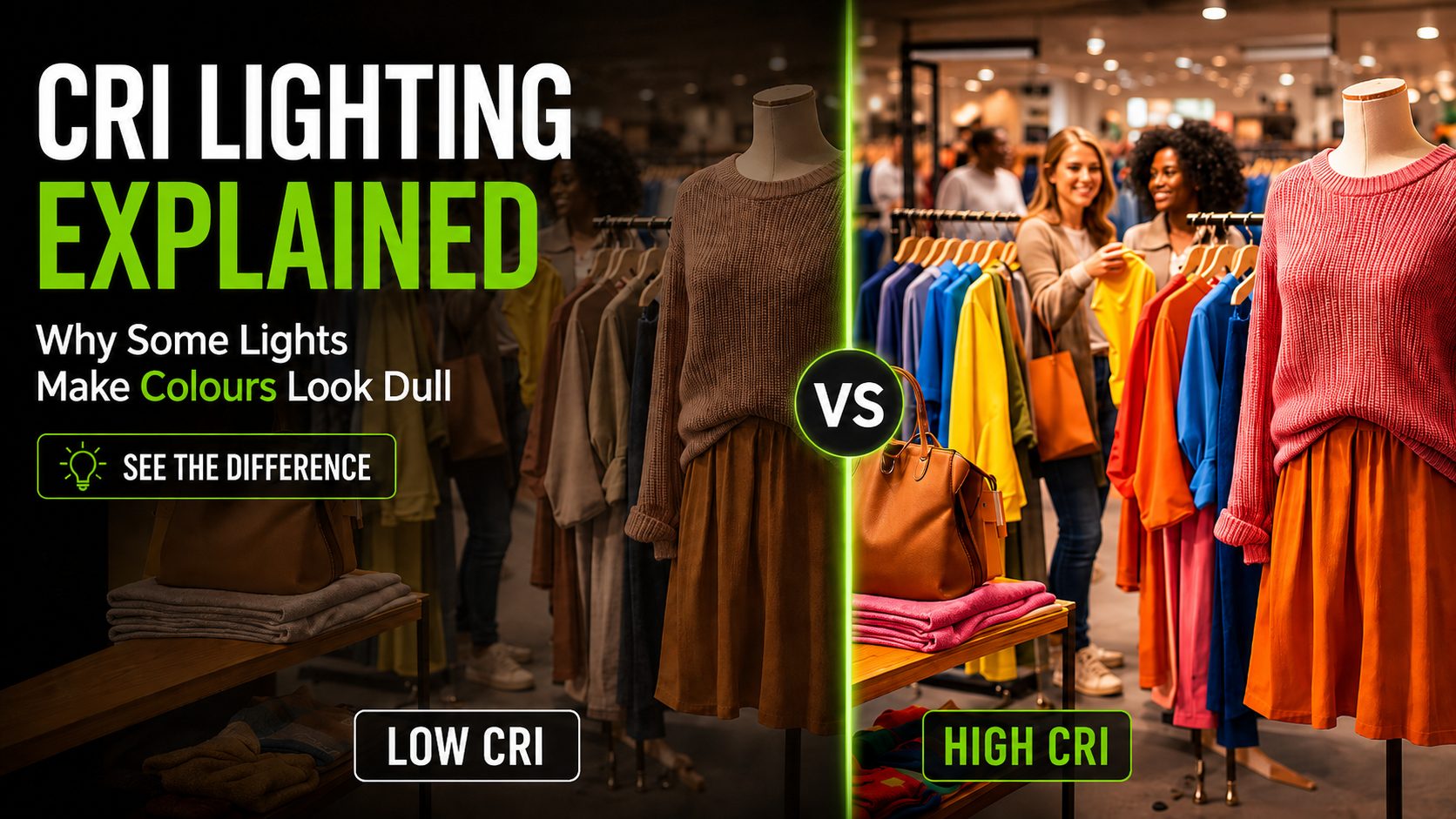
When choosing LED lighting, most people look at wattage, brightness, colour temperature and price.
These are important, but there is another specification that can make a major difference to how a space looks and feels: CRI lighting or Colour Rendering Index. Understanding CRI lighting is one of the most effective ways to improve the quality, accuracy and visual comfort of any LED installation.
CRI is one of those lighting terms that sounds technical, but the idea is actually simple. It tells you how accurately a light source shows the true colours of objects, materials, finishes, products and spaces.
For end users, architects, contractors and lighting professionals, understanding CRI can help prevent poor lighting decisions – especially in spaces where appearance, detail and visual comfort matter.
At Mesmerize Lighting, we assist clients in specifying the correct LED lighting solutions for each application – helping you avoid guesswork and ensuring your lighting performs as expected.
What Does CRI Mean?
CRI stands for Colour Rendering Index. It is a measurement of how naturally and accurately colours appear under a light source when compared to a reference light source, such as natural daylight.
CRI is measured on a scale from 0 to 100. The closer the CRI is to 100, the more accurately colours appear.
| A low CRI light may make colours look dull, flat or slightly distorted. | |
| A high CRI light helps colours appear more natural, vibrant and true to life. |
In simple terms: CRI tells you how well a light lets you see colour properly.
See CRI in Action
Drag the sliders below to see how CRI and colour temperature affect how a real space looks.
[cri_widget]
Why Is CRI Important?
CRI is important because lighting does not only help us see. It also affects how we experience a space. The same room, product, surface or material can look very different under different light sources.
A higher CRI light helps ensure that colours, textures and finishes are represented more accurately. This can improve the appearance of a space, support better design decisions and help avoid disappointment after installation.
A simple example: a clothing store
|
Low CRI
|
High CRI
|

What Is Considered a Good CRI?
For many general lighting applications, a CRI of 80 or above is commonly accepted as suitable. However, certain spaces require better colour accuracy.
| CRI Rating | Typical Use |
|---|---|
| CRI 70+ | Basic utility or industrial areas where colour accuracy is not critical. |
| CRI 80+ | General commercial, office, residential and industrial lighting. |
| CRI 90+ | Retail, hospitality, galleries, salons, showrooms, healthcare and design-sensitive spaces. |
The right CRI depends on the application. Not every project requires CRI 90+. The key is knowing where colour accuracy matters – and where it does not.
Where Is High CRI Lighting Most Important?
High CRI lighting is especially important in spaces where colour, appearance and detail influence decisions or experience.
| Retail stores Products need to look appealing and accurate. Poor colour rendering affects how customers perceive clothing, cosmetics, furniture and merchandise. |
|
| Restaurants and food displays Meat, fruit, baked goods and prepared meals can look fresh and appetising under the correct lighting, but flat or unappealing under poor lighting. |
|
| Showrooms Whether it is tiles, sanitaryware, kitchens, furniture or flooring, customers need to see colours and finishes correctly before making decisions. |
|
| Hotels and hospitality spaces High CRI lighting improves the appearance of interiors, materials, food, décor and skin tones – contributing to a more premium and comfortable environment. |
|
| Offices and workspaces Good colour rendering improves visual comfort. In design studios, architecture firms, print environments or creative workspaces, higher CRI may be necessary. |
|
| Healthcare and clinics Accurate colour visibility supports observation, comfort and task performance in clinical environments. |
|
| Homes and residential projects CRI affects how finishes, furniture, artwork, flooring and wall colours appear. High CRI lighting can make a home feel warmer, more natural and more refined. |

CRI vs Colour Temperature: What Is the Difference?
CRI and colour temperature are often confused, but they measure different things.
|
Colour Temperature Refers to the colour appearance of the light itself, measured in Kelvin.
|
CRI Refers to how accurately that light shows the colours of objects, measured 0-100.
|

Why CRI Matters – For Every Stakeholder
For architects
Materials are carefully selected. Finishes are coordinated. Colours are specified with intention. But if the lighting does not render those colours properly, the design can lose impact. High CRI lighting helps protect the design intent by ensuring that surfaces, textures and colours appear closer to how they were selected.
For contractors
Even when the installation is technically correct, poor lighting quality can lead to client dissatisfaction. By selecting the correct CRI from the start, contractors can reduce the risk of complaints, replacements and project delays.
For end users
Most end users may not ask for CRI by name, but they will notice the result. Poor CRI lighting often gets described as:
| “The colours look off.” | |
| “The room feels dull.” | |
| “The products do not stand out.” | |
| “The lighting feels harsh.” | |
| “The finishes looked different before.” |
What to Consider When Specifying CRI
When choosing the correct CRI for a project, consider the following:
| What is the space used for? Different spaces have different requirements. A warehouse, office, showroom and restaurant should not be treated the same. | |
| Are colours and finishes important? If the space includes products, fabrics, food, décor, artwork or premium finishes, CRI becomes more important. | |
| Will people make decisions based on what they see? In retail, showrooms and design environments, accurate colour rendering can directly influence decision-making. | |
| What atmosphere should the space create? CRI works together with colour temperature, beam angle, glare control and lighting layout to create the final visual effect. | |
| Is the product quality suitable? Not all LED products are equal. Work with lighting suppliers who understand performance, application and specification. | |
CRI Is Only One Part of Good Lighting
While CRI is important, it should not be considered in isolation. A good lighting specification should also consider:
| Lumen output | Glare control |
| Wattage and efficiency | Mounting height & spacing |
| Colour temperature | IP rating |
| Beam angle | Dimming requirements |
| Application suitability and product quality | |
CRI helps with colour accuracy, but the full lighting result depends on the complete specification. This is why working with the right lighting partner matters.
Better CRI Lighting Means Better Colour Confidence
CRI lighting is one of the simplest ways to understand how well a light source reveals colour. For general lighting, CRI 80+ may be suitable. For spaces where colour accuracy, appearance and detail matter, CRI 90+ may be the better choice.
The most important thing is not always choosing the highest CRI. It is choosing the right CRI lighting for the right application. To see how this applies to specific products, you can browse the Mesmerize Lighting product range or read our guide on LED lighting for different applications.
For further reading on colour rendering standards and how they are measured, the Illuminating Engineering Society (IES) provides authoritative guidance used by lighting professionals globally.
With the right guidance, you do not need to guess. You can specify with confidence.
[cri_blog_cta]


