
Tonight, when the sun goes down, you will probably flip a switch.
A room will light up. A street will glow. A parking area will become visible. A pathway will feel safer. And most of us will not think twice about it.
But for most of human history, that simple switch did not exist. When the sun disappeared, the world became dark. Roads, homes, pathways and open spaces became difficult to move through. People could not rely on streetlights, floodlights, security lights or outdoor lighting to guide them.
For thousands of years, darkness controlled the night. Today, street lighting gives us control over it.
Street lighting is one of the most visible forms of public infrastructure, yet it is often only noticed when it is absent, inadequate or poorly maintained. A well-lit street does more than help people see where they are going, it influences how people move, how businesses operate, how communities feel after dark, and how safely roads can be used by drivers, pedestrians, cyclists and public transport users.
In South Africa, where communities range from dense urban environments to industrial zones, residential suburbs, townships, rural roads and commercial precincts, street lighting plays an essential role in daily life – supporting visibility, safety, accessibility and public confidence.
This is why street lighting should never be treated as a generic outdoor lighting product. The correct streetlight needs to be specified for the environment, the application and the long-term demands of the area it serves.
At Mesmerize Lighting, we understand that street lighting is not simply about placing a luminaire on a pole. It is about creating dependable illumination that supports real communities, real roads and real conditions.
The Story of Light – A Brief History of Street Lighting
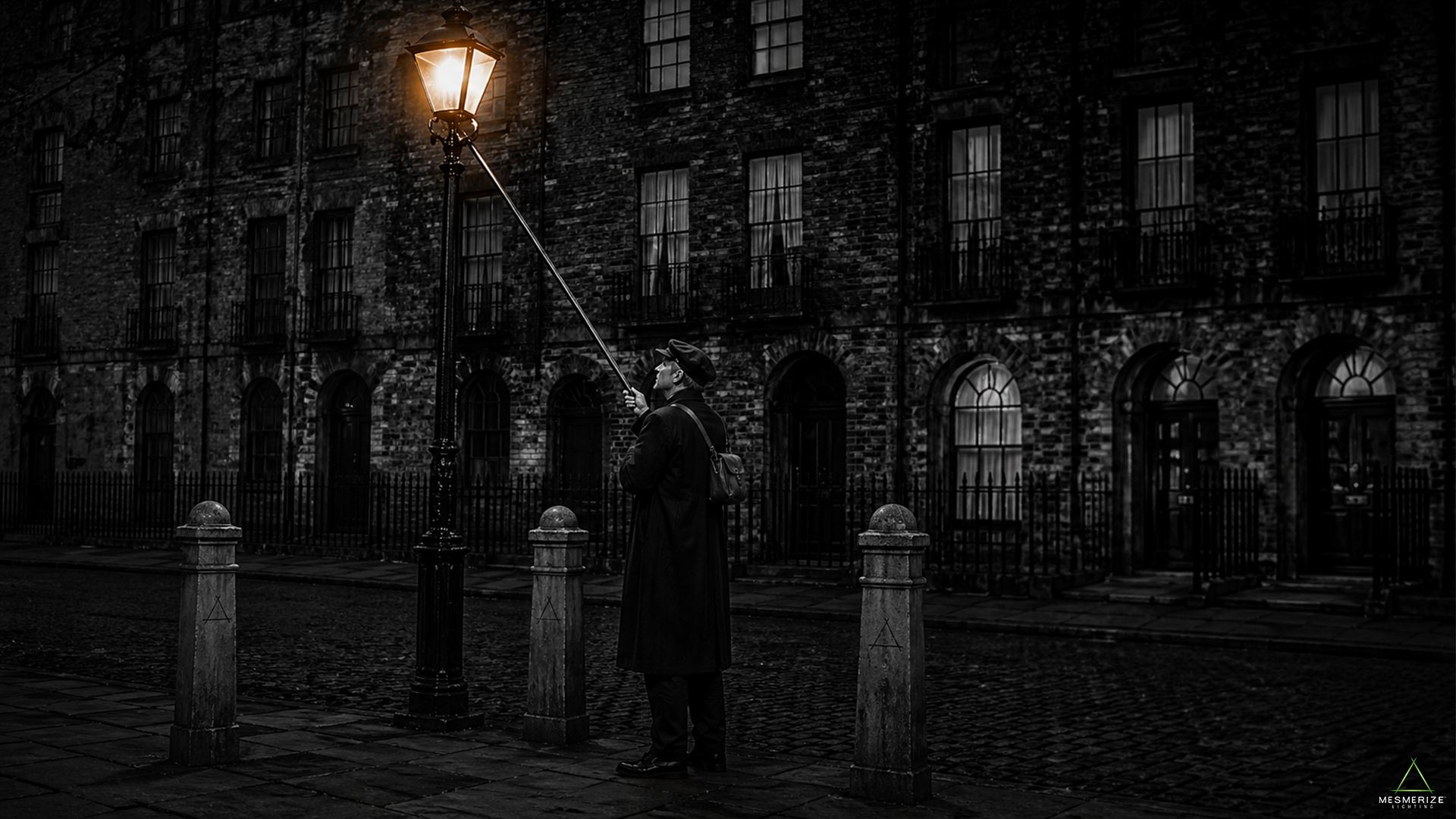
Before artificial lighting, people depended on the moon, the stars and whatever fire they could keep burning. Fire was humanity’s first lighting system, it created visibility, safety and a gathering point after sunset. But fire had real limits: it could only light a small area, needed constant fuel and could not serve streets, roads or large public spaces.
As human settlements grew, the demand for better public lighting grew with them:
| 1600s: Cities like Paris began organising street lamp systems using candles and oil lanterns to improve public safety and night-time navigation. | |
| 19th Century: Gas street lamps became widespread, extending evening activity and improving visibility in rapidly growing urban areas. | |
| Early 20th Century: Electric street lighting transformed public infrastructure, providing stronger and more consistent illumination as part of modern city planning. | |
| Mid-to-late 20th Century: Technologies progressed through incandescent, mercury vapour, sodium vapour and metal halide lighting, each improving on the last. | |
| Today — LED Era: LED street lighting has become the preferred solution globally, offering superior energy efficiency, better light control, longer lifespan and significantly reduced maintenance requirements. | |
While technology has evolved across these centuries, the purpose has remained the same: to make public spaces more functional, visible and secure after dark.
Why Street Lighting Matters
Street lighting affects far more than the appearance of a road. It directly influences how people use public spaces and how safe those spaces feel after dark.
Key benefits of effective street lighting
| Improved road visibility for drivers, pedestrians and cyclists | |
| Reduced dark spots that create risk or concealment in public areas | |
| Greater community confidence and comfort after sunset | |
| Support for businesses operating early in the morning or after dark | |
| Better movement around schools, hospitals, residential areas and transport routes | |
| Improved visibility for security personnel and surveillance systems | |
| A stronger sense of order and care in public environments |
Important distinction: Brighter is not always better. Poorly controlled lighting can create glare, waste energy, spill light into unwanted areas and reduce visual comfort. Good street lighting is about delivering the right amount of light, in the right direction, with the right distribution, for the right application.
Why It Is Important to Specify the Correct Streetlight
Not all streetlights are designed for the same environment. A residential road, a main access route, an industrial park, a parking area and a public transport zone all have fundamentally different lighting requirements. Specifying the wrong streetlight can create several problems:
| An underpowered luminaire leaves dark patches between poles, reducing visibility and creating uneven, unsafe lighting | |
| Poor optical control causes light spill into unwanted areas or creates glare for drivers and pedestrians | |
| Incorrect product selection leads to higher maintenance costs and reduced performance over time | |
| Premature product failure in demanding outdoor conditions | |
| Wasted electricity from inefficient or oversized fittings |
What modern streetlight specification considers
| Lumen output | Glare control |
| Beam angle and light distribution | Energy consumption |
| Optical control | Ingress protection (IP) rating |
| Mounting height and pole spacing | Durability and weatherproofing |
| Colour temperature | Maintenance requirements |
| Application suitability | |
In South Africa, outdoor lighting also needs to account for heat, dust, wind, moisture, electrical fluctuations, long operating hours and challenging installation environments. Durability, reliability and correct product selection are not optional, they are essential.
Street Lighting in the South African Context
South Africa has a unique and demanding lighting landscape. Our roads and communities are diverse , a single lighting approach cannot serve every environment equally.
| Environment | Key Lighting Considerations |
|---|---|
| Residential suburbs & estates | Safety, pedestrian comfort, aesthetic appeal, access security |
| Industrial parks & commercial zones | High lumen output, wide coverage, durability, security integration |
| Municipal roads & main routes | IES-compliant beam patterns, long pole spacing, energy efficiency, low maintenance |
| Rural access roads | Robustness, solar viability, minimal infrastructure dependency |
| Public transport routes | Consistent illumination, extended operating hours, pedestrian visibility |
Communities need lighting that works consistently. Municipalities and developers need products that support long-term infrastructure planning. Electrical contractors need luminaires that are reliable, installable and suited to site conditions.
Street lighting is not only a product decision. It is an infrastructure decision.
How LED Technology Has Changed Street Lighting
Modern LED lighting helps solve the same problem humans have faced for thousands of years: how do we make the night safer, more visible and more useful? The difference is that today, we can do it more intelligently, with better optics, greater efficiency and smarter control.
Advantages of LED street lighting
| Significantly improved energy efficiency over older technologies | |
| Better optical control for precise, targeted light distribution | |
| Longer operating lifespan – reducing replacement frequency | |
| Lower long-term maintenance requirements and costs | |
| More consistent and even illumination across the road surface | |
| Reduced light pollution with properly shielded optics | |
| Lower long-term operating costs for municipalities and developers |
Street Lighting Is More Than Illumination
The value of street lighting is often measured in watts, lumens and efficiency. While those technical factors are important, they only tell part of the story. Street lighting affects how people experience their environment, how safe a road feels, whether people are comfortable moving through an area after dark, and how well businesses, public services, transport routes and residential communities function.
When done correctly, street lighting becomes part of the social and economic infrastructure of a community. It:
| Creates safer roads for drivers, cyclists and pedestrians | |
| Improves visibility in public spaces after dark | |
| Supports security operations and surveillance systems | |
| Reduces energy costs for municipalities and project owners | |
| Lowers long-term maintenance pressure | |
| Makes outdoor spaces more functional and accessible after sunset |
For most of human history, darkness controlled what people could do after sunset. Today, lighting gives us control over the night – and with modern LED technology, that control can be more efficient, more reliable and more sustainable than ever before.
The question is no longer simply: “Can we light the night?”
The real question is: Can we light it better?
With the right LED street lighting, the answer is yes.
[street_lighting_blog_cta]